

Built around pattern matching
Flaws in app-specific implementations and business logic don't fit a template.
Penetration testing powered by autonomous AI agents. We surface only the risks that can actually be exploited—each one backed by proof.
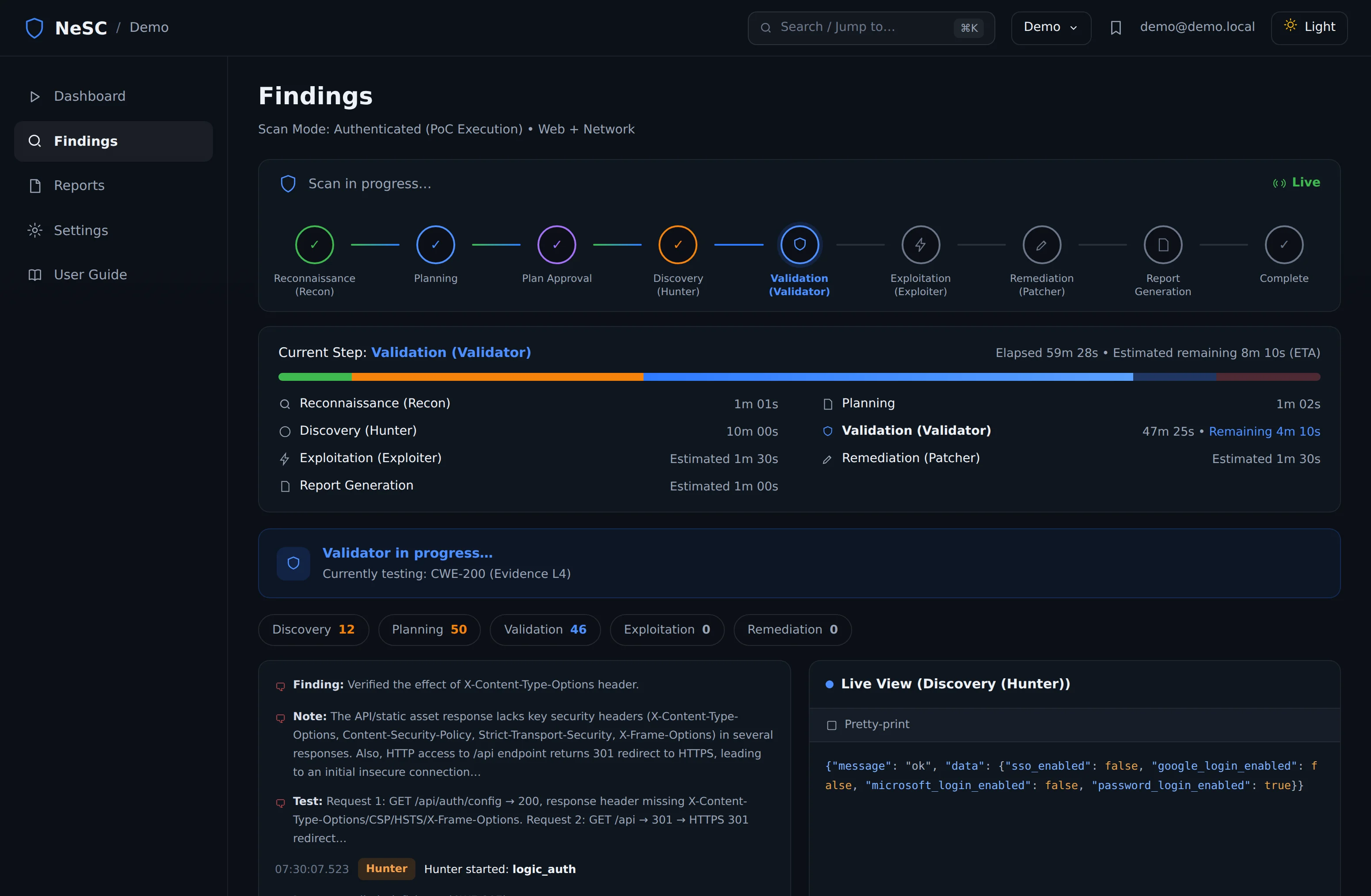
Vulnerability discovery, exploit generation, attack automation. The cycle from reconnaissance to intrusion has collapsed, and a few spot assessments a year can no longer keep up.
Facing an AI-powered adversary with human effort alone is an asymmetric fight.
Multiple AI agents explore your attack surface in parallel, without pause—delivering coverage and repetition beyond human reach, at a consistent level of precision.
It maintains sessions and inspects even the admin APIs that surface scans can never reach.
It links weaknesses together to verify how far an attacker could actually get.
It safely reproduces the exploit and shows what is genuinely dangerous, with evidence.
Traditional web vulnerability scanners (DAST) are a strong security foundation—broad and reproducible. But their approach has structural limits.
Flaws in app-specific implementations and business logic don't fit a template.
It doesn't understand what an endpoint protects, so severity ends up uniform.
It can't push past the authentication wall or chain weaknesses into an attack path.
It can flag what “might exist” but never proves what's “exploitable,” so real risk gets buried in noise.
| Dimension | Traditional Scanner (DAST) | NeSC |
|---|---|---|
| Core approach | Match against a checklist | Explore autonomously, like an attacker |
| Detection method | Matching known patterns | Contextual reasoning and real attacks |
| Inside authentication | Limited reach | Maintains auth and sessions to dig deep |
| Chaining weaknesses | One-off findings | Chains weaknesses into an attack path |
| Proof (PoC) | Virtually none | Safely demonstrates exploits with evidence |
| Severity judgment | Uniform, mechanically scored | Prioritized by understanding critical assets |
| False-positive control | Relies on manual triage | An independent verification stage assigns confidence |
If scanners provide breadth of coverage, NeSC provides depth of attack and proof. The two are complementary.
An orchestrator directs the whole assessment while multiple Hunter agents, each with a distinct role, explore in parallel. Every agent runs a ReAct loop—like a human tester, it autonomously repeats “try, observe, decide the next move.”
Each finding is assigned a confidence level from 1 to 10, promoted as more supporting evidence is gathered.
It identifies the assets worth protecting first, then surfaces attack paths tied directly to business impact.
The most serious flaws hide behind the login. NeSC inspects internal endpoints too.
It unifies TLS analysis, port scanning, and network scanning inside an isolated sandbox.
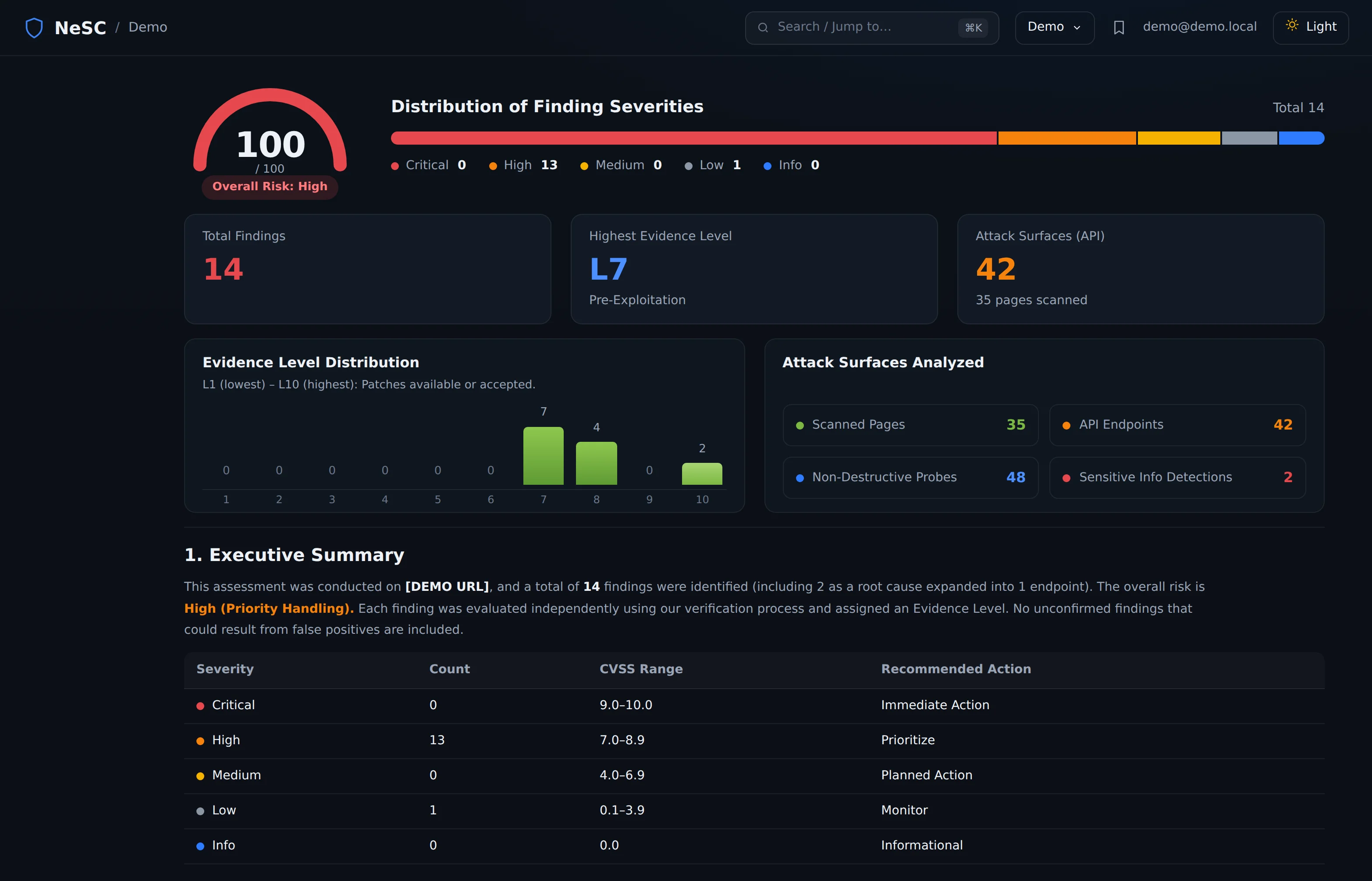
On targets a checklist assessment cleared as “no issues,” NeSC has uncovered risks that are genuinely exploitable.
Used by hundreds of companies and tens of thousands of users
By exploring inside the authentication boundary that scans couldn't reach, NeSC surfaced exploitable risks—each one with proof.
The risks invisible to surface scans were waiting deeper in.
Findings are automatically mapped to ISO/IEC 27001:2022 Annex A controls, with risk presented in CVSS.
No destructive action runs without an operator's explicit approval.
Testing runs in an isolated sandbox, keeping any impact on availability under control.
Every action is recorded append-only, with a hash chain and Merkle tree to detect tampering.
The assessment scope is fixed by hash, so only authorized targets are tested.
Start by choosing a single target. NeSC will explore deep into the system and return the results, backed by proof.
Contact